
Reward or Motivation? What makes people get themselves vaccinated?
A Cohort Experimental Study to Promote Pro-Vaccination Behavior using a Chatbot in Chennai, India.
TL;DR
In this research, we studied how a Chatbot can help promote vaccination rates, through enhanced communication and incentives to promote pro-vaccination behavior.
The Indian Government implemented an online portal through which people can check for vaccination availability and make appointments to take the vaccination. However, it has been about the quickest-finger appointments get completely booked as slots open.
This randomized controlled trial helps understand the impact of large-scale messaging combined with incentives for individuals to get COVID19 vaccination.
60 participants were randomly assigned into one of the three groups- conspicuous, generic and a control group.
After two months, it was understood that there was no significant difference between the incentivized group and the control group, which shows that with access to vaccination, people were willing to get the vaccination.
There was no statistically significant difference in the effectiveness of the messaging.
However, the lack of availability was one of the key reasons vaccination rates were low.
Need for Study
The benefits of widespread vaccination reduce the number of COVID-19 cases.
Vaccination also reduces the transmission of the virus.
The Center for Disease Control and Prevention (CDC) approximates that even 1 per cent increase in vaccination rates could reduce 96,600 illnesses, 46,400 medical visits, and 1390 hospitalizations
Current Scenario
India recently opened its doors to vaccinating 18 to 45-year-old people long after the vaccination drive was kickstarted 50 years and over individuals.
Vaccination rate improvement can be split into three categories- increasing the opportunity to get oneself vaccinated, increasing incentives, and education about the vaccination and its benefit.
Features to consider
The focus of this randomized controlled trial that studies a chatbot developed for large-scale messaging, along with the prospect of providing minimal incentives.
It is understood that ‘nudging’ can be used to push both healthcare providers and prospective vaccines. The behavioral constraint, the degree of difficulty associated with the planned intervention. This builds on the concept of design constraint
Previous research
In research conducted by Stockwell et al., there was an improvement in vaccination among children and teenagers using SMS messaging.
Other researchers also concluded that there is an increase in vaccination rates among adults in a primary care setting when intervened with an SMS service

Methodology
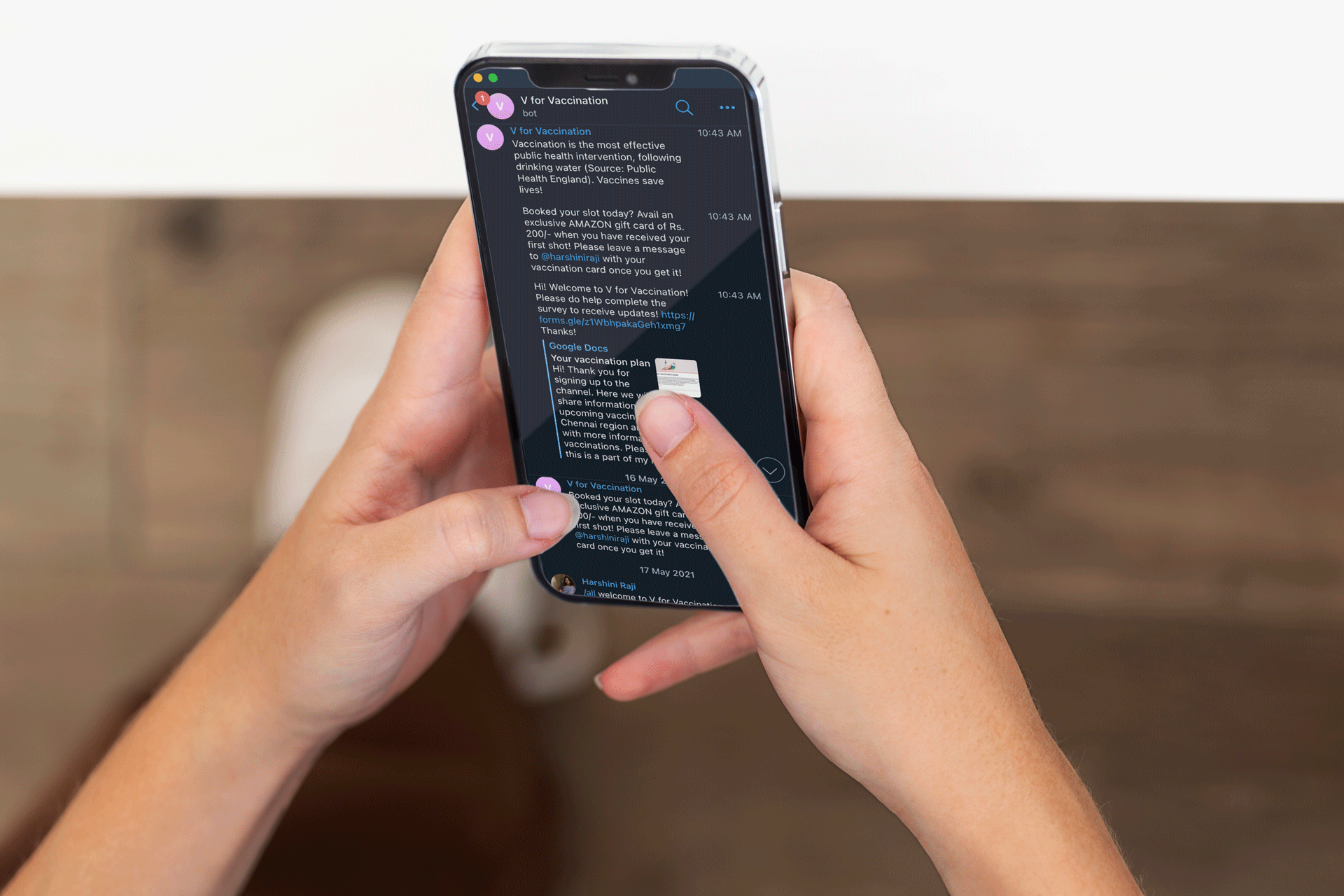
The Chatbot was build using the available API from the Government of India website- https://apisetu.gov.in/ , wherein people can enter their location or pin code and receive updates about vaccination slots available for their age group within their locality.
The research uses a population of 60 individuals, residing in Chennai, India. They were recruited using a mass social media promotional activity, where the participants were free to subscribe to the chatbot to receive updates about vaccination slots opening up around the Chennai region.
The three groups each will receive three types of messaging:
a. Group 1: Will receive messages that give incentives for getting themselves vaccinated.
b. Group 2: Will received messages that use positive messaging to promote pro vaccination behavior. There will be no mention of rewards.
c. Group 3: The control group will simply receive vaccination slots availability updates. There will be no mention of rewards or conspicuous messages.
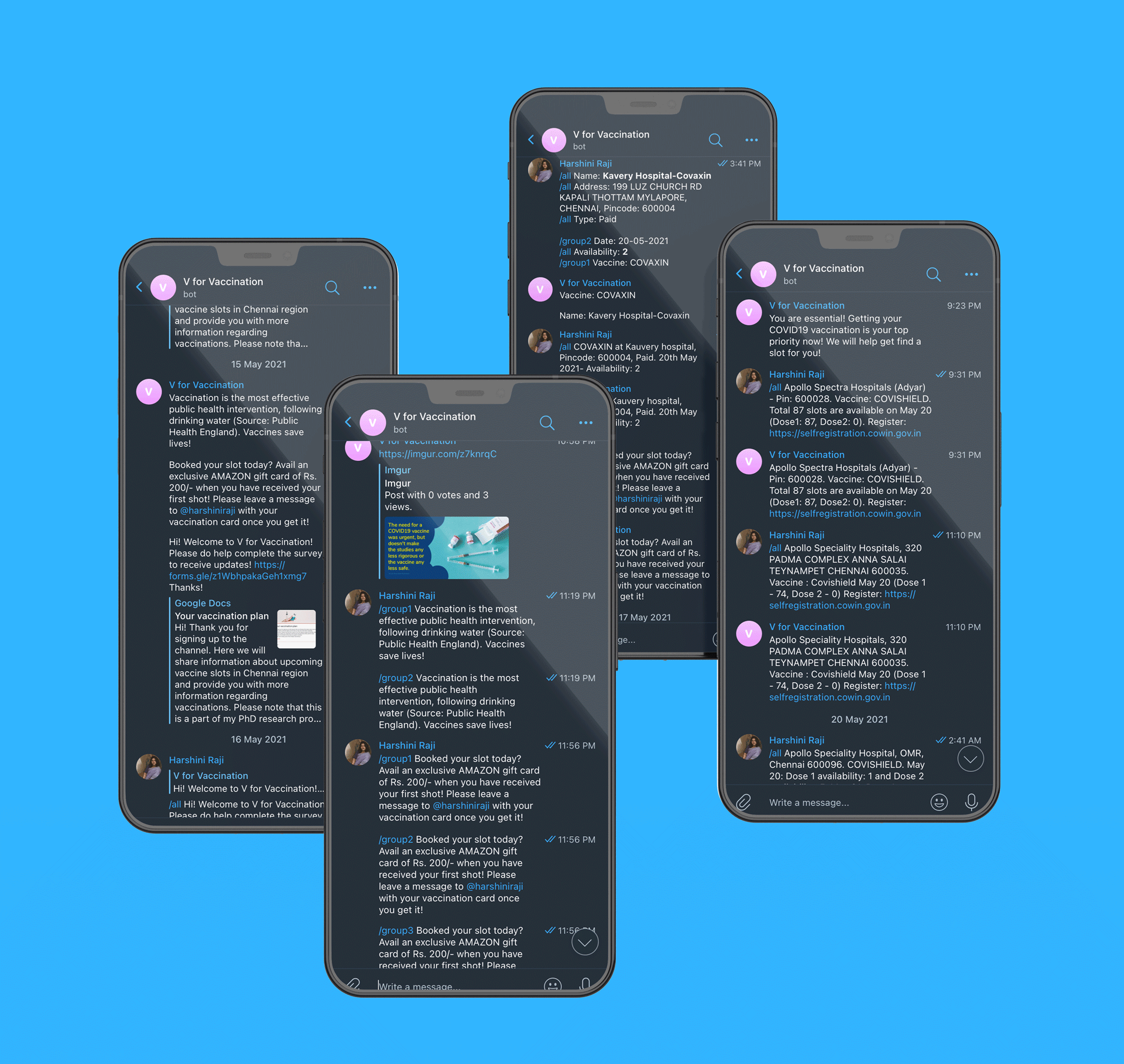
The participants in group 1, the conspicuous group, received messages where they were informed that they could get an Amazon gift voucher once they receive their first vaccination slot. Members in group 2, the generic group, received messages about pro-vaccination behavior, and recommendations for the vaccines, but no incentivized messages or mention of rewards. Members in group 3, the control group received only vaccination slot opening updates.
Post intervention, a brief poll was inserted in the Chatbot, which helped understand how many participants were able to book their slots using the Chatbot and how many were rewarded. Participants from group 1 submitted their proof of vaccination to the researcher to receive their rewards. It was understood that out of 60 participants, five were inoculated from group 1, two from group 2 and three from group 3.
Results
Limitations & Biases
People ignoring the messages although their notifications maybe turned on.
the availability of the vaccination was minimal and the income group was not considered when testing the intervention.
However, since all of the study groups could have been equally affected by this bias, any differences between the groups can still be credited to the interventions, and that was the primary aim of the research.
Another consideration that can be kept in mind is that the behavior of the participants may have changed over the 4 weeks of intervention.
They might have been affected by the virus, or one of their family members may have been affected or their understanding of the impact of the vaccination in itself might have altered during this period.
One of the primary concerns of participants was the availability of their choice of vaccination. Some wanted to Covishield whereas some wanted Covaxin.
Conclusion
Although 73% of the participants showed interest in receiving their vaccination, only 13% were able to get themselves vaccinated.
Although research group 1 was incentivized, not many were able to book the desired slots.
This clearly signifies that when there is limited accessibility to vaccination, even if the group exhibits the need to get themselves vaccinated, if it is not accessible, any form of intervention or campaigning will not help them in getting themselves vaccinated.
Although incentives were provided for the participants in group 1 to get themselves vaccinated, that was not the primary motive of the participant’s interest in vaccination.
Expanding the research for a longer time to see the number of people motivated to get themselves vaccinated when vaccination is available in abundance will help understand the impact of the incentivized and positive messaging.
Future studies can help in addressing the gaps in the current research and thereby increase the learning of motivation of inoculation, leading to preparedness for future public health problems.